
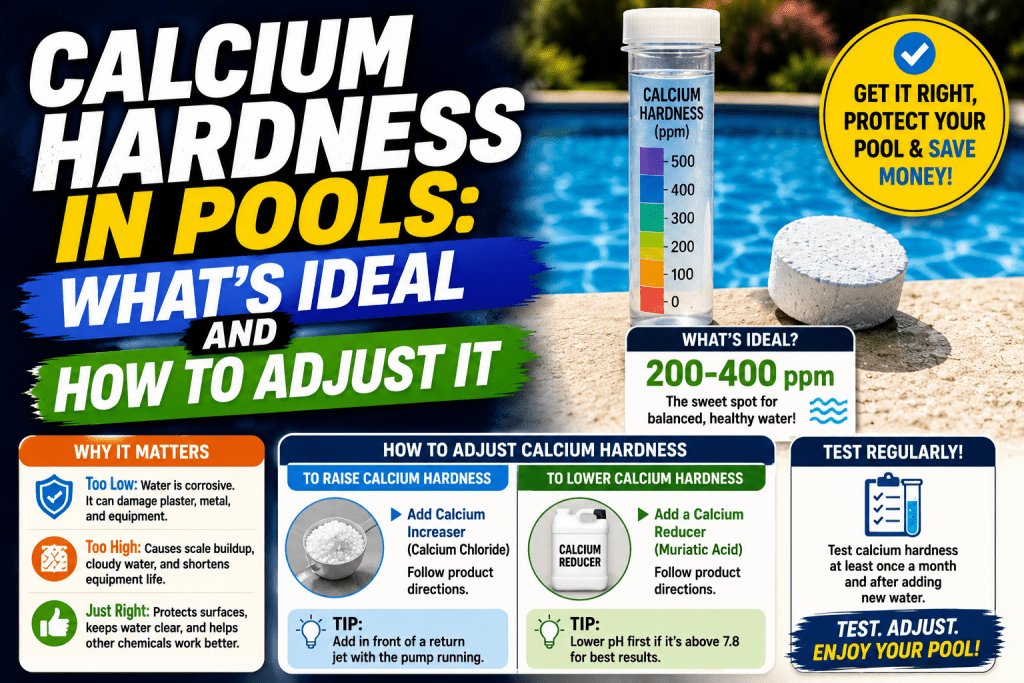
Calcium Hardness in Pools: What's Ideal and How to Adjust It
Share
Calcium hardness in a pool should be kept between 200 and 400 ppm (parts per million). Below 200 ppm, your water becomes aggressive and starts dissolving calcium from pool plaster, grout, and equipment. Above 400 ppm, you get scale buildup on surfaces and inside your pipes. Most pools do best right in the middle - around 250 to 350 ppm. If your number is outside that window, this article tells you exactly what to do about it.
Why Calcium Hardness Matters More Than People Think
Calcium hardness is one of those chemistry numbers that doesn't cause a dramatic problem right away, so pool owners tend to ignore it until something goes wrong. The issue is that by the time you notice the damage - pitting on your plaster, scale caked on your tile, a heater exchanger that's half clogged - you're already looking at a repair bill. Water chemistry works like a slow drip: small imbalances add up quietly over months and seasons.
The reason calcium matters is physics. Water wants to be in equilibrium. If your pool water is low in calcium, it will pull calcium from the nearest available source: your plaster, your grout, your stone coping, the copper in your heat exchanger. This process is called aggressive water or corrosive water, and it's the main reason older plaster pools get that rough, chalky, pitted texture. On the flip side, water with too much calcium has nowhere to put the excess, so it deposits it as scale everywhere it touches.
What's the Ideal Calcium Hardness Range for Your Pool Type?
The target range varies slightly depending on your pool's surface material:
- Plaster and gunite pools: 250 to 350 ppm is the sweet spot. These surfaces are calcium-based, so they're the most vulnerable to corrosive water.
- Vinyl liner pools: 175 to 225 ppm. Vinyl doesn't dissolve like plaster, but low calcium still affects water balance and can degrade fittings and equipment.
- Fiberglass pools: 175 to 225 ppm. Same reasoning as vinyl - the surface itself is less reactive, but water balance still matters for equipment protection.
If you have a pool heater, stay toward the lower end of your acceptable range. Heat causes calcium to fall out of solution faster, which accelerates scale formation inside the heater - one of the most expensive components to replace or service.
How to Test Calcium Hardness Accurately
A basic test strip will give you a rough idea, but for calcium hardness specifically, a liquid drop test kit gives you a much more reliable reading. The titration method used in drop kits is more accurate than the color-match strips, which can be hard to read and drift in bright sunlight. Test your water at least once a month during swimming season, and always test at the start of the season before you balance anything else.
If you want a second opinion, most pool supply stores will test your water for free. Take a sample from about 18 inches below the surface, away from any return jets, for the most accurate read. Water near jets or the surface isn't representative of what's actually circulating through your system.
How to Raise Calcium Hardness in a Pool
If your calcium is too low, the fix is straightforward: add calcium chloride. This is the standard product for raising calcium hardness, and it works quickly - usually within a few hours of adding and circulating. Our Calcium Hardness Increaser For Pools is calcium chloride formulated for pool use, and it dissolves cleanly without clouding the water when you add it correctly. The key word there is correctly - there are a few things you need to do right.
- Calculate your dose first. As a general rule, 1.25 lbs of calcium chloride raises calcium by about 10 ppm in a 10,000-gallon pool. Figure out your pool volume and how many ppm you need to raise, then do the math before you open the bag.
- Pre-dissolve in a bucket of pool water. Pour the calcium chloride into a bucket of water (not water into the chemical - that reaction generates heat). Stir until dissolved, then pour it slowly around the perimeter of the pool.
- Add in increments if raising more than 30-40 ppm. Large jumps in calcium can temporarily cloud your water. Add half your dose, run the pump for a few hours, then add the rest.
- Run the pump for at least 4 to 6 hours after adding to fully distribute the chemical.
If your calcium is dramatically low - under 100 ppm - check out our deeper guide on how to fix low calcium hardness in your pool, which covers more severe situations and what to watch for while you're correcting it.
How to Lower Calcium Hardness in a Pool
There's no simple chemical you can add to pull calcium out of solution. The practical options are limited, and this is where pool owners sometimes get frustrated. Here's what actually works:
- Partial drain and refill: This is the most reliable method. Drain 25 to 50 percent of your pool and refill with fresh water. If your tap water is itself high in calcium (above 200 ppm), this won't help much - you'd just be replacing hard water with hard water. Test your fill water first.
- Flocculant or clarifier: Some pool owners use a calcium-specific flocculant to precipitate excess calcium to the bottom, then vacuum to waste. This works, but it's labor-intensive and works best when calcium is only modestly elevated.
If you're in an area with naturally high calcium in the tap water, you may have to manage your pool chemistry more actively. A calcium sequestrant can help keep dissolved calcium from forming visible scale even when levels are elevated, buying you time between partial drains. When calcium gets very high and starts depositing as white flakes or crust, you may want to read about what causes white flakes in pool water to understand whether you're dealing with calcium scale or something else.
The Langelier Saturation Index: Calcium Doesn't Work Alone
Calcium hardness doesn't exist in a vacuum. Its effect on your water depends on how it interacts with pH, total alkalinity, water temperature, and stabilizer (CYA). The Langelier Saturation Index (LSI) is a formula that takes all of these factors together and tells you whether your water is corrosive, balanced, or scale-forming. A score of 0 is perfectly balanced. Below -0.3, your water is aggressive. Above +0.3, scale is likely forming.
The practical takeaway: even if your calcium reads at 300 ppm, your water can still be corrosive if your pH or alkalinity is low. Balance all your chemistry together, not one number at a time. Chasing one parameter while ignoring the others is the most common mistake pool owners make when troubleshooting water problems.
Common Mistakes When Managing Calcium Hardness
- Adding too much at once. Dumping a full 10 lb bag into the pool at once almost always clouds the water temporarily and stresses your other chemistry. Go slow.
- Ignoring fill water calcium levels. If you top off your pool frequently due to evaporation, calcium accumulates over time because it doesn't evaporate with the water. This is the main reason pool calcium creeps up through the season even without adding any product.
- Balancing calcium without checking pH first. High pH and high calcium are a recipe for rapid scale formation. Get your pH between 7.4 and 7.6 before you adjust calcium.
- Using test strips for borderline readings. If you're close to an edge - say 190 ppm or 410 ppm - get a drop test or a store test before you decide to adjust. Strips at those margins aren't reliable enough to make a good call.
Frequently Asked Questions
What is the ideal calcium hardness level for a pool?
The ideal range is 200 to 400 ppm for most pools. Plaster and gunite pools do best between 250 and 350 ppm. Vinyl and fiberglass pools can run a little lower, around 175 to 225 ppm, since their surfaces are less reactive than plaster.
What happens if calcium hardness is too low?
Water with low calcium is aggressive - it pulls calcium from wherever it can find it, including your pool plaster, grout, and equipment. Over time this causes pitting, etching, and surface deterioration that's expensive to repair. Low calcium also accelerates corrosion of metal fittings and heater components.
What happens if calcium hardness is too high?
High calcium causes scale deposits on pool surfaces, tile, and inside your pipes and equipment. You may notice white crusty buildup along the waterline or cloudy water that won't clear up even after shocking. Inside a heater, scale acts as insulation and causes the unit to overheat and fail prematurely.
How do I lower calcium hardness in a pool?
The only reliable method is to drain a portion of the pool and refill with fresh water. If your tap water is also high in calcium, this helps less - consider a partial dilution combined with a sequestrant to keep calcium from forming scale while you manage levels over time.
How much calcium hardness increaser do I need to add?
A general benchmark: 1.25 lbs of calcium chloride raises calcium hardness by about 10 ppm in a 10,000-gallon pool. Always calculate your full pool volume and dose before adding anything. Add in smaller increments and retest before adding more, especially if you need to raise levels by more than 30 to 40 ppm.
Calcium hardness is the kind of number that rewards staying ahead of it. Keep it in range, test monthly, and you'll avoid the slow damage that catches pool owners off guard after a few seasons. The repairs are never as cheap as a 10-pound bag of calcium chloride.